What owners and tenants need from a property manager's website
A property management site has two audiences who want opposite things. An owner comparing managers wants to know what you handle, what needs their sign-off, how they hear about money and what the fee comes to. A tenant wants to report a leaking tap without wading through a sales pitch aimed at landlords.
Both groups need certainty about process. Owners worry about repairs they never approved. Tenants worry that a request has vanished into an inbox. The website is often the first place either of them checks.
So the site has a clear set of jobs. It must split owners and tenants early, show the fee arithmetic, explain the scope in writing, take routine repair requests in a usable form and send emergencies to a phone, not a form.
How the demo handles it
Canalstead Property Management is a fictional Ottawa company that VirtueInfo created for this demo. It is not a client, and its fees and contact details are samples. The pages and forms all work, so you can try them as an owner or as a tenant.
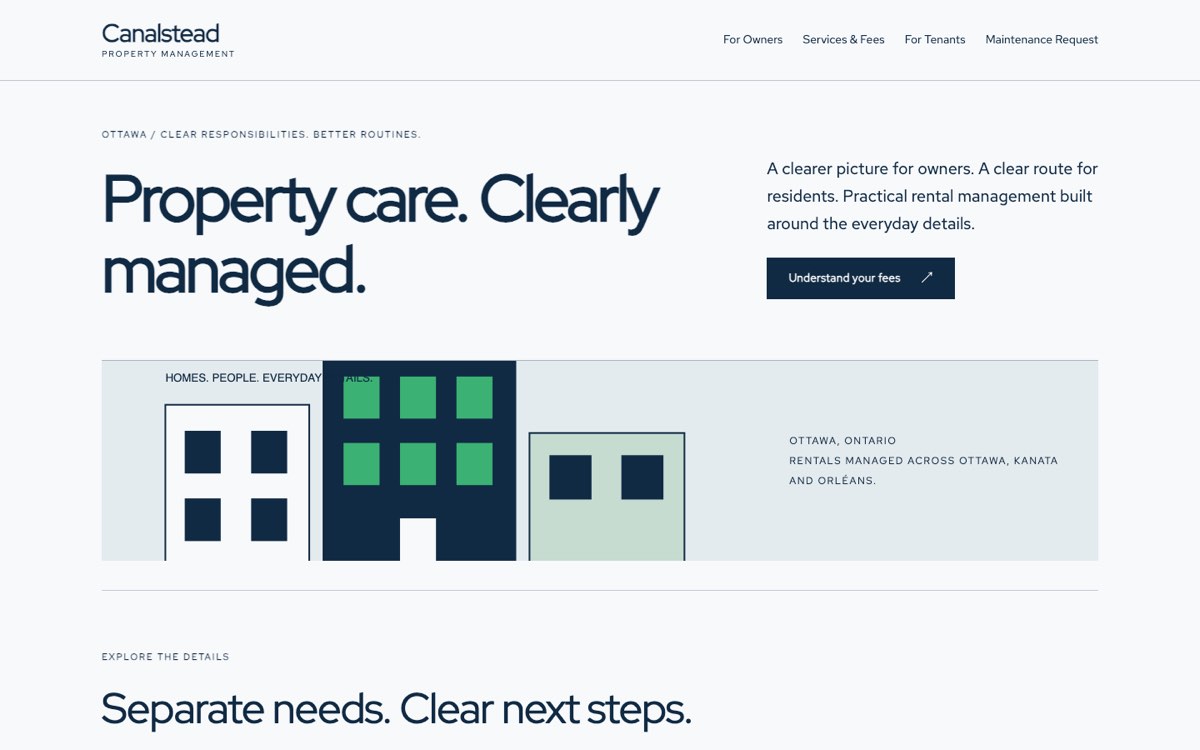
The home page offers three routes: one for owners, one for fees and one for tenants. Each has a short summary and a link, and a closing section names the neighbourhoods the company covers, from Centretown condos to duplexes in Westboro and Vanier.
The For Owners page reads like the first meeting. It covers the property visit, the repair spending limit, which decisions come back to the owner and what a monthly statement shows. An enquiry form sits at the end and asks owners to keep leases and banking details out of it.
The signature feature is the fee calculator on the Services and Fees page. An owner enters a monthly rent in Canadian dollars and picks one of two plans. The result shows the monthly fee and the amount left before other costs, updated as they type. Next to it, the page states what the figure leaves out, and that the final fee comes in a written proposal. The two plans are then compared, with seasonal checks such as furnace servicing listed under the extended plan.
The For Tenants and Maintenance Request pages take the tenant side. They explain what details help, what happens after a request arrives and when to phone instead. The form asks for a category, a preferred day that cannot be in the past and a description, and moves the cursor to the first field that needs attention.
Local SEO built in
Each page carries schema.org structured data for a RealEstateAgent, the type search engines use for property managers, with the city served and office hours. Inner pages add Service and breadcrumb markup.
Page titles are written around local searches: "residential property management in Ottawa" on the home page, "property management for Ottawa owners" on the owner page and "Ottawa rental maintenance requests" on the tenant form. Neighbourhood names such as Kanata, Orléans and Barrhaven appear in the text. The business name, hours and service area line up with your Google Business Profile.
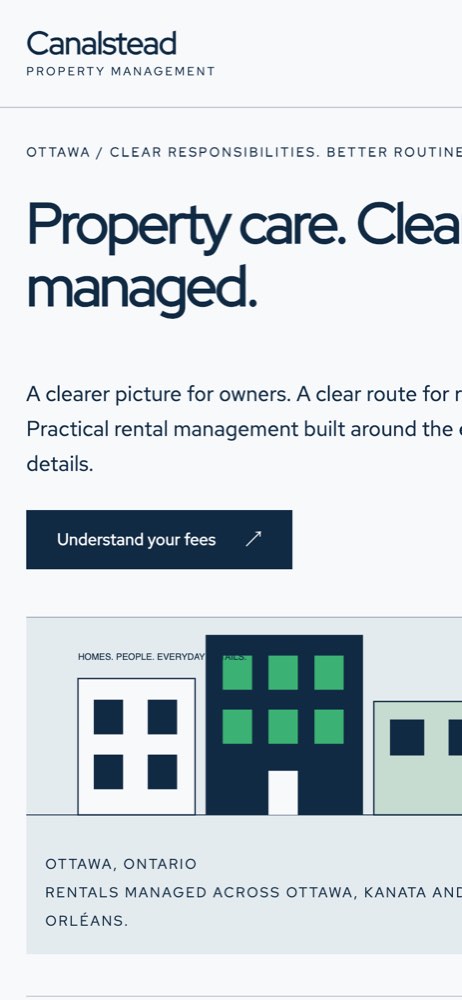
The artwork is an original panoramic drawing in code, and the fonts load from the same server. Pages stay light and fast on a phone. The demo is kept out of search results because Canalstead is fictional. Because Canalstead Property Management is invented, its demo stays out of search results, while a real property manager site launches open to Google with a sitemap and canonical tags.
Notes for each market we serve
India
We write in Indian English with fees in rupees. Owners who live abroad are a large group for managers in India, so the owner page can cover rent remittance and reporting in their time zone. Tenants often prefer WhatsApp to a form, and rent by UPI is common, so both can appear on the tenant page.
USA
We switch to American spelling and dollars, and the fee calculator can add leasing or placement fees if you charge them. Many states expect property managers to hold a real estate broker license, so the license number goes in the footer. Fair housing wording belongs on tenant and leasing pages.
Canada
The demo is already Canadian: Canadian spelling, fees in Canadian dollars plus HST and winter maintenance on the checklist. In Québec we add a full French version. Provinces differ on licensing for property managers, so we show whatever registration applies in yours.
Australia
We use Australian spelling, dollars and GST, and show your agency licence and ABN in the footer. Owners compare a percentage fee plus letting and inspection charges, so the calculator can list them line by line. Routine inspections and the condition report get their own section on the tenant page.
Finland
We build the site in Finnish, Swedish and English, with fees in euros including VAT. Rental management is often bought by private landlords with one or two flats, so a simple fixed monthly fee may suit the calculator better than a percentage. Your business ID goes in the footer.
What we deliver and how the project runs
We design to your brand and write the owner and tenant pages with your managers, from the scope documents and statements you already use. If your fee structure has several parts, the calculator is built to match it.
Owner enquiries and maintenance requests go to the right place: email, WhatsApp, your CRM or your property management software. Urgent issues stay on the phone line.
At hand-over you get the code, the hosting setup and notes on editing fees, areas and service text. We build tools like the calculator as custom application development, so they follow your rules instead of a template's.
Tell us how many doors you manage and how requests reach you today, and ask us for a quote.