What clients need from an interior designer's website
People who look for an interior designer usually have one room or one house in mind, and a worry they cannot solve alone. A terrace owner wants more light and storage without building up. An apartment owner wants the kitchen redone and needs to know how the designer works with the builder and the owners' corporation. A family wants a whole-home scheme over a few years and needs to trust that the studio will see it through to installation.
The website has to answer these people in order. It should show the rooms you design and the way you think about light, layout and materials. It should show finished projects in detail, explain stages and fees plainly, make a first visit easy to request, and be found by people searching in their own suburb.
How the demo site handles it
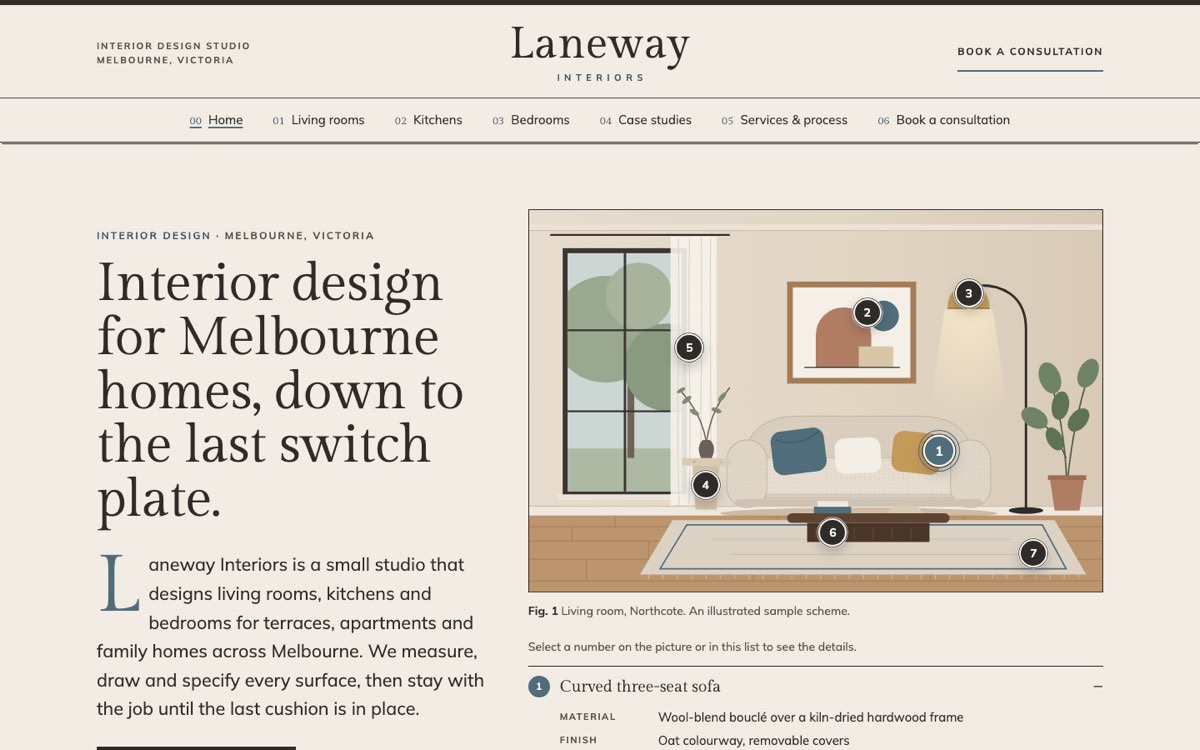
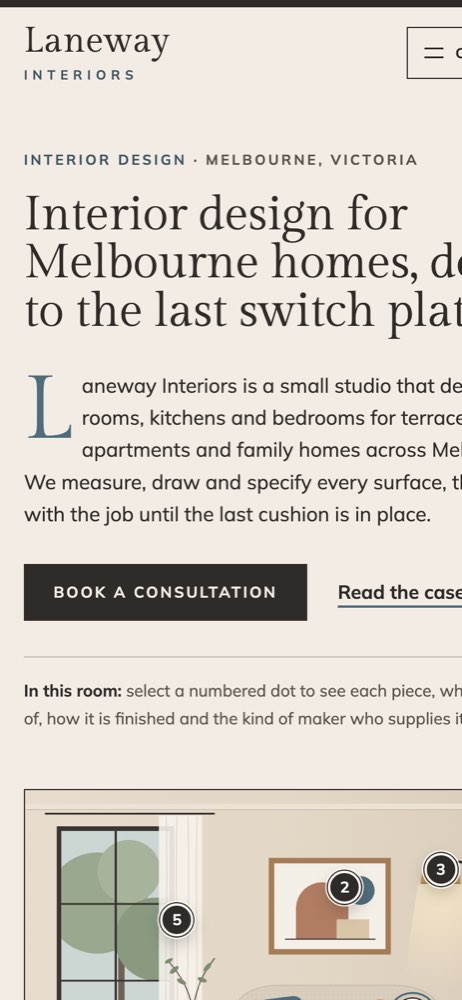
Our demo is Laneway Interiors, a fictional studio in Melbourne, Australia that VirtueInfo created to show the kind of site we build. It is not a client. The design follows an editorial magazine style, with a centered masthead, a numbered contents bar, pull quotes and figure captions.
The home page opens with a drawn living room. Numbered dots sit on the sofa, the lamp, the rug and the artwork. Selecting a dot shows what the piece is made of, how it is finished and the kind of maker who supplies it. The same feature runs on the living room, kitchen and bedroom pages. It works with a keyboard and a screen reader, and the full list of pieces is visible even when JavaScript is off, so search engines and assistive technology read the same content.
The two case studies go further. Each one starts with the client's brief in their own words, then shows a floor plan with numbered points that explain what changed: hall joinery in a narrow terrace, an arch where a kitchen wall used to be in an art deco flat.
The services page sets out four ways to work with the studio in a fee table, followed by a six-step process from consultation to handover. The booking page holds a consultation form that asks which rooms, a budget range, the type of home, the start date and the suburb. On a phone, the contents bar becomes a button that opens a full-screen contents page.
Local SEO built into every page
Each page carries structured data that describes the studio as a ProfessionalService with its city, region, opening hours and service area, plus a Service entry for each type of work and breadcrumbs on inner pages. Page titles pair the room with the city, such as kitchen interior design in Melbourne, so each page targets its own search. Service area wording names greater Melbourne and explains how far the studio travels.
We keep the business name, address, phone and hours identical to your Google Business Profile, so search engines see one consistent business. The pages use local font files and lightweight drawings, which keeps them fast on a phone. Search engines are told to skip the Laneway Interiors demo. When we build for a real interior designer, the site is indexable from launch, with canonical tags and a sitemap in place. Your site launches fully indexable, with a sitemap and search console set up.
Notes for each market we serve
India
Clients often prefer to start a conversation on WhatsApp, so we put a WhatsApp button next to the consultation form. Fees can be shown in rupees, and if you take a booking deposit we can add UPI payment. Pages can be written in English with Hindi or a regional language where your clients expect it.
USA
We write in American English and show fees in US dollars. Some states regulate the use of certain professional titles in interior design, so we place your credentials and any registration exactly as you supply them. Online booking with a calendar is common, and we connect the form to your booking system if you use one.
Canada
Fees appear in Canadian dollars, and the site can show whether sales tax is included. If you work in Québec, we build a French version with its own page titles and schema, not a translated copy pasted below the English.
Australia
The demo is written in Australian English, shows fees in Australian dollars including GST and keeps a place for the ABN in the footer. Clients often ask how a designer works with the builder, so the services page answers that directly. Apartment projects usually involve an owners' corporation, which the case study content can explain.
Finland
We build the site in Finnish, Swedish and English where you need them, each with its own URLs and language tags. Prices are shown in euros including VAT, and the business ID appears in the footer.
What we deliver and how the project runs
We design the site to your brand: your typefaces, colors and logo, with drawings or photographs of your own projects in the hotspot rooms. We write or edit the content with you, including room pages, case studies and fee wording, so it reads like your studio.
The consultation form can send requests to your email, WhatsApp, your CRM or your booking system. We set up the structured data, page titles and sitemap, then align the details with your Google Business Profile. The project runs in stages: brief, design review, a staging build, then launch. At hand-over you get access to edit rooms, hotspots and case studies yourself, and our UI and UX design team can keep refining the site as your portfolio grows. We also offer ongoing maintenance for updates and security.
To see what a site like this would involve for your studio, ask us for a quote and tell us which rooms and projects you want to show first.